Thursday, July 27, 2017

Britain bans gasoline and diesel cars starting in 2040

https://www.blogger.com/blogger.g?blogID=5384954664324883494#editor/target=post;postID=4207944134572388282

Britain will ban sales of new gasoline and diesel cars starting in 2040 as part of a bid to clean up the country's air.

The decision to phase out the internal combustion engine heralds a new era of low-emission technologies with major implications for the auto industry, society and the environment.
"We can't carry on with diesel and petrol cars," U.K. environment secretary Michael Gove told the BBC on Wednesday. "There is no alternative to embracing new technology."
Almost 2.7 million new cars were registered in the U.K. in 2016, making it the second biggest market in Europe after Germany.
Meeting the 2040 deadline will be a heavy lift. British demand for electric and fuel cell cars, as well as plug-in hybrids, grew 40% in 2015, but they only accounted for less than 3% of the market.
Still, experts say sales of clean cars are likely to continue on their dramatic upward trajectory.
"Ending diesel and petrol car sales by 2040 is a step in the right direction but given that electric cars are coming anyway this is probably pretty irrelevant. It's a bit like saying we're banning the sale of steam engines by 2040," said David Bailey, a professor of industrial strategy at Aston Business School.
The car industry says that demand for electric vehicles will only reach a tipping point once they're cheaper to own than conventional vehicles.
"Much depends on the cost of these new technologies and how willing consumers are to adopt battery, plug-in hybrid and hydrogen cars," said Mike Hawes, CEO of the Society of Motor Manufacturers and Traders. "Consumers have concerns over affordability, range and charging points."
The deadline was announced by the government on Wednesday as part of a plan to reduce air pollution. The blueprint highlighted roughly £1.4 billion ($1.8 billion) in government investment designed to help ensure that every vehicle on the road in Britain produces zero emissions by 2050.
Gove said action was needed because gasoline and diesel engines contribute to health problems, "accelerate climate change, do damage to the planet and the next generation."
Roughly 40,000 deaths in Britain each year are attributable to outdoor air pollution, according to a study published last year by the Royal College of Physicians. Dirty air has been linked to cancer, asthma, stroke and heart disease, among other health issues.
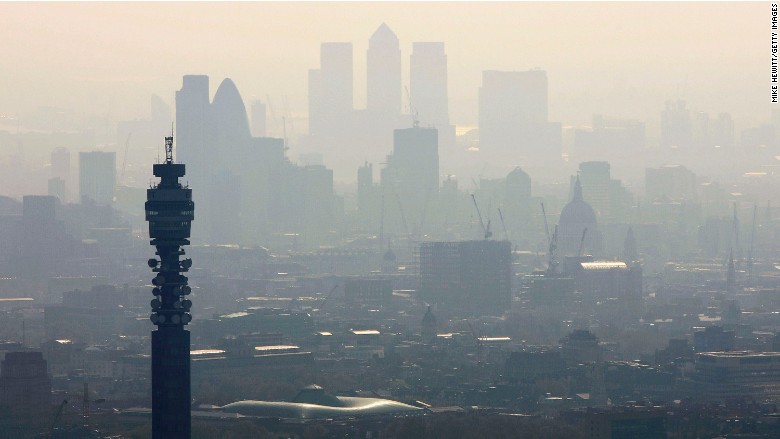
london pollution
Air pollution blankets London.

The problem is especially pronounced in big cities. London surpassed the European Union's annual limit for nitrogen dioxide exposure just five days into the new year, according to King's College. The university estimates that air pollution is responsible for 9,400 premature deaths in the city every year.
The timeline for ending sales of internal combustion engines mirrors one proposed in early July by France. President Emmanuel Macron has given the auto industry the same deadline to make the switch to cleaner tech.
"We are quite rightly in a position of global leadership when it comes to shaping new technology," Gove said.
But the auto industry, which supports over 800,000 jobs in the U.K., is wary of hard deadlines.
Andy Palmer, CEO of British luxury automaker Aston Martin, said that ditching conventional engines will require much more planning and investment.
"To make a moonshot work, you need to have a NASA," he told CNNMoney. "If you don't want to export jobs out of the U.K., you need to create that capability and that infrastructure ... we're a long, long way from having that capability today."
Other countries have been even more ambitious than the U.K. India is planning to stop selling gas-powered vehicles by 2030.
The German car industry and government officials will meet in early August to discuss the future of diesel engine technology. Manufacturers are trying to avoid diesel cars being banned from German towns and cities.

Monday, June 5, 2017

Monetisation of Associated Gas from Offshore Flares​


http://www.petronas.com.my/TechChallenge/Pages/CurrentChallenge.aspx

Monetisation of Associated Gas from Offshore Flares​


REQUEST FOR PROPOSAL DESCRIPTION
  
PETRONAS is looking at economic solutions to monetise Associated Gas (AG) from offshore flaring facilities which has neither existing gas utilisation nor evacuation infrastructure. The objective is to beneficially utilize the hydrocarbon resource and reduce the carbon footprint and intensity. 
Proposals are requested for innovative and commercially viable technology solutions for monetizing excess associated gas at offshore facilities that shall meet the following requirements:
• Do not comprise conventional gas evacuation facility
• Not a modular addition to the existing platform
• Minimise or eliminate continuous flaring
• Commercially viable
• Meets all regulatory requirements related to upstream activities with good and modern petroleum practices in Malaysia

Wednesday, April 5, 2017

Installation Methodology Ophir WHP


The platform for the Ophir development off Malaysia is set to commence its journey to the field from the Muhibbah Engineering yard at Port Klang.
Project co-owner Octanex revealed Monday the jacket and topsides had been loaded out onto transport barges and would be transported to the field shortly.
Upon arrival, the 350-tonne platform will be installed by Dutch company SPT Offshore which has been subcontracted by Muhibbah for the transport and installation of the platform.
The Ophir field is being developed via three production wells, a well head platform and a floating production, storage and offloading vessel.
It was reported last month Malaysian contractor MTC Engineerig had bought an oil tanker - Puteri Bangsa - for conversion into the MTC Ledang FPSO which will be used at the field.
Output at the $90 million Ophir development is expected in the second half of the year.
The Ophir oilfield is being developed under a risk service contract. The co-owners are Octanex (50%), along with Malaysian companies Scomi Energy (30%) and Vestigo Petroleum (20%).

http://www.upstreamonline.com/live/1232090/ophir-platform-loaded-out

Wednesday, November 2, 2016

Triple Offset Valves used as Isolation Application

Can Triple Offset Butterfly valve used as isolation application?
Many engineers are not aware Triple Offset Butterfly valve can be used as isolation valve, and it benefit in term of saving in weight, space and most importantly, cost.


Triple Offset Valves in Upstream Applications


Triple offset valves provide an efficient solution for critical and non-critical applications when positive isolation is required in upstream oil and gas operations. Their compact nature offers savings in weight and space and most importantly, cost.
Most onshore and offshore installations traditionally use ball valves and occasionally gate valves for the majority of flow isolation applications. Specifications typically call for 6D valves, but engineers seldom look beyond these specifications to other valve types with similar or better performance.
Many of these engineers are not yet aware that in many offshore isolation applications, a triple offset valve (TOV) offers benefits in terms of weight, overall dimensions and performance versus the standard ball or gate valve. A TOV can be the right choice for applications in the turret of a floating production storage and offloading vessel (FPSO), and in virtually all topside process applications of FPSOs and platforms such as separators, water treatment, gas compression and other systems.
Today’s TOVs, with pressure ratings up to ASME Class 1500 and zero leakage, cover enough applications to achieve significant savings in weight and space, as well as total cost of ownership.

Wednesday, March 30, 2016

FLNG market update

Petronas FLNG 1

With the low oil price environment dampening project sentiment.
Below are list of FLNG projects status:

1: Petronas’ PFLNG1 is expected to commence operations in 2016
2: Ophir Energy’s Fortuna FLNG still set for mid-2016 FID
3: ENI’s Coral FLNG development plan approved by Mozambique
4: Delfin FLNG project pushing ahead at for Port Delfin project
5: Petronas Delays PFLNG2
6: Browse FLNG decision delayed
7: Exmar, PEP cancel Caribbean FLNG deal

Saturday, December 5, 2015

Accident: An offshore oil platform in Azerbaijan’s section of the Caspian Sea


4 Dec 2015

A major fire has broken out on an offshore oil platform in Azerbaijan’s section of the Caspian Sea. The company says one person died and 32 were evacuated - while 30 more are missing.


The fire started overnight at a rig at the Gunashli field southeast of Neft Daşları (Oil Rocks) settlement. It was caused by strong winds that damaged a gas pipeline on the platform, the Azeri state energy company SOCAR said.

"The fire in the gas pipeline has not been completely extinguished and it has not been ruled out that it could spread to oil and gas wells near the platform," it stated.

The rescue operation was hampered by stormy weather with waves rising up to 11 meters high, Trend news website reported.

Initial statements did not mention those missing. The order signed by President Ilham Aliyev to launch a probe into the fire only said 1 person was killed and 32 were saved.


At the same time, the independent Oil Workers' Rights Protection Committee told Reuters that over 30 platform workers were killed in the blaze.

"According to our information, 32 workers died, while 42 workers were rescued last night," said Mirvari Gakhramanly. He later told the AP those were not dead, but missing.

SOCAR eventually confirmed people were missing, but put the number at 30.

"One body was found and a search-and-rescue operation for 30 missing workers is under way," the oil company said in a statement.

Local reports suggest one of the rescue boats was overturned in rough sea.

The search and rescue mission continues.

It is still not clear how many people worked on the rig. The Azeri news agency ARA says 63 people were there, which doesn’t match the numbers provided by the independent committee.


In a separate incident in the area, the storm waves hit a small house near e Caspian shore with three people inside who remain missing, according to the news website Day.Az.

https://www.rt.com/news/324844-azeri-oil-platform-fire/

Monday, July 13, 2015

US labels DuPont as ‘severe’ safety violator after chemical plant accidents

Four workers died in November 2014 after being poisoned by exposure to methyl mercaptan,
which is used to make insecticide at DuPont’s La Porte, Texas, plant.
PHOTO: MARIE D. DE JESUS/HOUSTON CHRONICLE/ASSOCIATED PRESS


OSHA placed DuPont in its severe violator program, which devotes additional resources to inspect companies with a “demonstrated indifference toward creating a safe and healthy workplace.”


DuPont Co. was placed in a US Department of Labor program for “severe” violators of workplace safety rules and was fined for more alleged infringements after the deaths of four workers last year at a Texas herbicide factory.

The proposed fines of $273,000 are for eight violations -- three “willful,” one “repeat” and four “serious” -- found at DuPont’s plant in La Porte, the department’s Occupational Safety and Health Administration (OSHA) said in a statement Thursday. The fines are in addition to $99,000 levied in May for nine violations related to the November deaths, OSHA said.

OSHA placed DuPont in its Severe Violator Enforcement Program, which devotes additional resources to inspect companies with a “demonstrated indifference toward creating a safe and healthy workplace.” CEO Ellen Kullman early in her career led the creation of a safety consulting business at the company.

“DuPont promotes itself as having a ‘world-class safety’ culture and even markets its safety expertise to other employers, but these four preventable workplace deaths and the very serious hazards we uncovered at this facility are evidence of a failed safety program,” Assistant Secretary of Labor David Michaels said in the statement.

A worker at the plant was overcome when a supply line released more than 20,000 lb of methyl mercaptan, a deadly chemical. Three more were asphyxiated by the colorless gas when they came to his aid in a failed rescue attempt. The latest fines stem from expanded inspections at the plant, OSHA said.

Plant Shutdown

DuPont is “disappointed” with its inclusion in the Severe Violator program as the company has worked to continuously improve its safety procedures since they were first implemented more than 200 years ago, said Dan Turner, a DuPont spokesman.

DuPont has shut the herbicide unit to fix any problems and will work with OSHA to better understand the latest citations and any additional abatement needed, he said.

“We believe we have identified and are addressing most if not all of OSHA’s significant findings,” Turner said in a e- mailed statement. “We have and will continue to take the necessary steps to ensure all units are safe to operate.”


Thursday, June 11, 2015

Magazine: Offshore Engineer & Chemical Engineering (June 2015)


Offshore Engineer
IN THIS MONTH'S ISSUE:
FEATURE: Offshore Renewables - A milestone is about to be reached in the tidal energy industry off the cold harsh coast of Scotland. Elaine Maslin spoke with the project director behind the MeyGen tidal array development. Tidal and wave energy projects are getting grid-wet this year, yet there's still more to learn. Emma Gordon reports from All Energy. Douglas Westwood's Rachel Stonehouse discusses the offshore wind market, where approximately US$330 billion could be spent in capex over the next 10 years, with cumulative capacity surpassing 57GW. 
Free Download: http://5xpan.com/fs/cboo6nle0e7795a978/


Chemical Engineering

VER STORY
Materials Selection in the CPI
An overview of the many factors to be considered when selecting materials of construction

Free Download: http://5xpan.com/fs/fbooenlede77e3fad2/


Unconventional Oil & Gas Report
IHS: Eagle Ford companies schedule wedge production

Free Download: http://5xpan.com/fs/5booanle8e7733ad82/

Friday, April 3, 2015

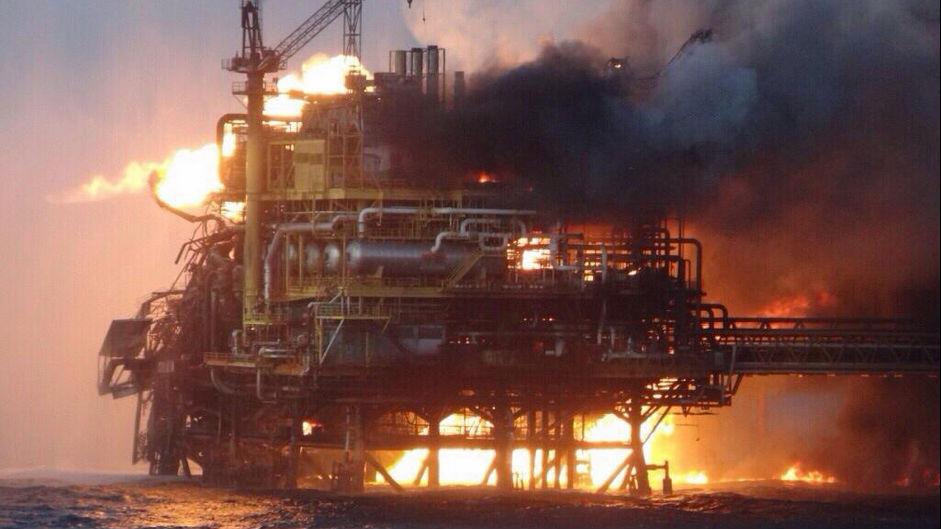
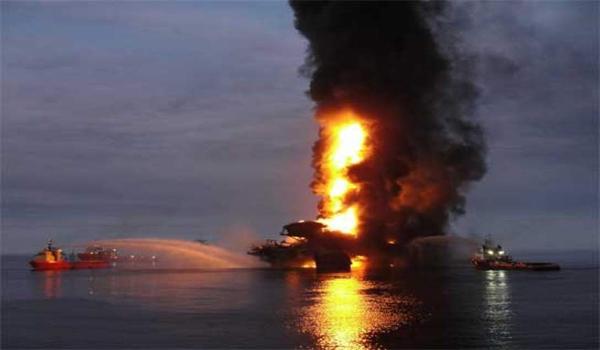
Accident: Pemex Abkatun Alpha platform fire, 4 killed

Photo courtesy of Carlos Hernández's Twitter (@carlitosahm)

Photo courtesy of Palparratas’ Twitter (@palparratas)

Photo courtesy of Grupo Presente’s Twitter (@DiarioPresente)

2015-04-01

At least four people died after a fire broke out on a Pemex oil processing platform in the Gulf of Mexico early on Wednesday, leading to the evacuation of 302 workers, the Mexican state-run oil company said.

The fire, which burned throughout the day, erupted overnight on the Abkatun Permanente platform in the oil-rich Bay of Campeche. Forty-five people were treated for injuries and 16 of them were hospitalized, two with serious injuries, Pemex said.

At 8pm (02:00 GMT) on Wednesday, Pemex said in a message on its Twitter account that the fire had been put out.

Eight firefighting boats had been brought in to battle the flames, Pemex said, noting that one of the fatalities was from the state-run giant and another was a contractor for Mexican oil services firm Cotemar. Two others have yet to be identified.

Videos posted on Twitter showed the offshore platform engulfed in flames, lighting up the night sky, as rescue workers looked on from nearby ships.

The fire broke out in the dehydration and pumping area of the platform, and it was not yet clear what caused it, Pemex said. There was no oil spill, it said.

Pemex Chief Executive Emilio Lozoya estimated the impact on production would be small because other processing sites nearby would pick up the slack, a company spokesman said.

Lozoya said at a local news conference in Ciudad del Carmen that the cause of the fire outbreak was still unknown, although he expected it was something related to mechanics.

President Enrique Pena Nieto promised a thorough investigation to find whoever or whatever was responsible to ensure such accidents are avoided in the future.

Part of the Abkatun Pol Chuc offshore complex, the damaged platform separates crude oil and gas from various wells to process around 40,000 barrels per day (bpd), work which has now been suspended, the Pemex spokesman said. Earlier in the day, the spokesman had said the platform produced oil.

In total, the Abkatun Pol Chuc complex produces around 300,000 bpd. Output at the rest of the site was not affected.

Mexico is the world's No. 10 crude producer at just under 2.3 million bpd, down about a third from a peak of 3.4 million bpd in 2004.

Pemex has had a number of accidents in recent years and the latest one comes as Mexico seeks to lure private investors to revive its flagging oil industry.

In 2013, at least 37 people were killed by a blast at Pemex's Mexico City headquarters, and another 26 people died in a fire at a Pemex natural gas facility in northern Mexico in September 2012.

Last year, Mexico finalized a reform to end Pemex's 75-year-old oil and gas monopoly, but expectations of a boom in private investment have been tempered by the plunge in global crude prices.

Cotemar is based in Ciudad del Carmen and provides offshore services to Pemex, according to its website.

Source: http://www.maritime-executive.com/article/fire-engulfs-pemex-oil-platform-300-evacuated


Thursday, February 12, 2015

Accident: Petrobras FPSO Cidade de São Mateus Explosion


Petrobras offshore rig explosion kills three

An explosion on an offshore oil and gas platform operated by Brazil's Petrobras has killed at least three workers.

State-run Petrobras said 74 workers were on board the rig at the time and six of them remain missing.

Brazil's oil industry regulator, ANP, says that a fire caused by the blast has been contained and the platform has been stabilised.

ANP also said that no oil leaked from the rig which was located off the coast of Espirito Santo state.

Health officials said that ten workers have been injured.

An official from the union representing workers on the platform said that a gas leak had caused the explosion.
http://www.bbc.com/news/business-31430467

Saturday, January 24, 2015

Shale Resources and Water Risks

How It Works


Hydraulic fracturing -- or hydro fracking, or just plain fracking -- is one way that we can get at "hidden" reserves of natural gas, petroleum -- even water. It sounds extremely complicated (and is, in fact, a pretty cool feat of science and engineering), but fracking is a fairly simple process. Way far underground (we're talking some 7,000 feet/2,133 meters below the surface), rocks like shale can hold gases, water or oil in their pores. Hydraulic fracking moves that resource from the pores of the rocks to production wells

Global Shale Gas Development: Water Availability & Business Risks


Experts from the World Resources Institute (WRI), Apache Corporation, and Natural Resources Defense Council will host a press call to discuss key findings from a new report, Global Shale Gas Development: Water Availability & Business Risks, the first-ever public analysis of water availability across all potential commercial shale resources worldwide. The press call will take place on Tuesday, September 2, 2014.

  • 38 percent of shale resources are in areas that are either arid or under high to extremely high levels of water stress;
  • 19 percent are in areas of high or extremely high seasonal variability; and
  • 15 percent are in locations exposed to high or extremely high drought severity.


Eight of the top 20 countries with the largest shale gas resources face arid conditions or high to extremely high baseline water stress where the shale resources are located; this includes China, Algeria, Mexico, South Africa, Libya, Pakistan, Egypt, and India.

Eight of the top 20 countries with the largest tight oil resources face arid conditions or high to extremely high baseline water stress where the shale resources are located; this includes China, Libya, Mexico, Pakistan, Algeria, Egypt, India, and Mongolia.

Shale basin and water stress in USA
Today shale development is rapid in USA, however there is medium to high risk to water resources.

Shale basin and water stress in Russia
Let go to Russia, shale basin found in less water risk zone. It means potentially to developing shale extraction.

Shale basin and water stress in China
China has largest shale resources in the world, and energy demand is high and growing 60% annual. Although China is rated as High risk, when zoom in to the country, some shale basin found in less water risk zone, like Sichuan (四川), Hubei (湖北).

Shale basin and water stress in SEA
How about South East Asia (SEA), some shale basins are found in Thailand and Indonesia, and they are in low risk zone.

An Inconvenient Truth: Fracking Shale

Fracking is required mix water with chemical to improve the performance well. The chemical content VOC (volatile organic compound), heavy metal, radioactive substance, etc. How to 100% ensure it wont leak and contamination to ecosystem?

Summary & Opinion

Shale extraction is the trend of Oil and Gas industry. The development of any shale field has considered technology, economic, and environmental risk.

As per data, USA is not suitable to develop shale field due to water resource risk. In money dominated era, everything is driven by money, other things (environment) can be put it aside.

Shale oil changes the world energy landscape, even leading the oil price down recently. It seem beneficial to US as oil importer. The shale oil and gas are booming and change the world, but what price to the people?

As a politician, authority, organisation, engineer, or people, everyone must has responsibility to the people, community, country, world, animals and plants. We have duty to preserve resource for next generation.

Oil price Jan - Dec 2014


References:

  1. How Hydraulic Fracking Works, http://science.howstuffworks.com/environmental/energy/hydraulic-fracking.htm
  2. Animation of Hydraulic Fracturing (fracking), https://www.youtube.com/watch?v=VY34PQUiwOQ
  3. An Inconvenient Truth: Fracking Shale, https://www.youtube.com/watch?v=uokmsSi7LTY
  4. World Resources Institute, http://www.wri.org/

Sunday, December 21, 2014

Crude Oil Benchmark

Glossary:

WTI (West Texas Intermedium) - WTI refers to oil extracted from wells in the U.S. It is light and sweet (low sulfur), a high quality crude oil. US as a big oil consumption country, coupled with the New York Futures Exchange in global influence, WTI crude oil futures is global benchmark of oil price. The public and the media usually say the number of dollars in oil, mainly refers to the WTI price.

Brent Blend - Similar to WTI, Brent is light and sweet crude oil too. At 23 June 1988, on London's International Petroleum Exchange (IPE) launched Brent crude oil futures contract, it been used as benchmark for the north-western Europe, North Sea, Mediterranean, Africa and Yemen and other countries and regions. Roughly two-thirds of all crude contracts around the world reference Brent Blend, making it the most widely used marker of all.

Dubai/Oman – This is a useful reference for oil of Middle Eastern crude. It is a slightly lower grade than WTI or Brent. This is benchmark of well-known OPEC (Organization of the Petroleum Exporting Countries) oil prices. It mainly export to Asian countries, therefore it tends to reflect the status of Asian demand for crude oil.

Source: IntercontinentalExchange (ICE) 

Friday, July 18, 2014

World Oil & Gas Review 2013

Oil


Total world proved oil reserves reached 1687.9 billion barrels at the end of 2013, sufficient to meet 53.3 years of global production. The largest additions to reserves came from Russia, adding 900 million barrels and Venezuela adding 800 million barrels. OPEC members continue to hold the majority of reserves, accounting for 71.9% of the global total. South & Central America continues to hold the highest R/P ratio. Over the past decade, global proved reserves have increased by 27%, or over 350 billion barrels.


Oil Price 1861-2013


Gas

World proved natural gas reserves at end-2013 stood at 185.7 trillion cubic metres (tcm), sufficient to meet 55.1 years of global production. Proved reserves grew by 0.2% relative to end-2012 data. An increase in the US (+7.1%) accounted for all of the net growth in global proved reserves in 2013. Iran (33.8 tcm) and Russia (31.3 tcm) hold the largest proved reserves.


References
  1. BP Statistical Review 2014, http://www.bp.com/en/global/corporate/about-bp/energy-economics/statistical-review-of-world-energy/statistical-review-downloads.html
  2. Eni O&G Review 2013, http://www.eni.com/world-oil-gas-review-2013/wogr.shtml
  3. List of countries by proven oil reserves,  http://en.wikipedia.org/wiki/List_of_countries_by_proven_oil_reserves

Saturday, June 7, 2014

Trigonometry Problem - Solution

A new solution for previous trigonometry problem.


In previous post, I have provided a solution for the problem by triangle area formula, however it seen complicated.
Recently, I have thought up a new solution for it.

Consider the triangle in Cartesian coordinate system, using linear equation for developing the equations for lines AB, AD, CE and BC.

First, assume length of AC is 1
line AB:  y = x tan (80)
line AD:  y = x tan (60)
line CE:  y =  x tan (110) - tan (110)
line BC:  y = x tan (100) - tan (100)

Point E is intersection of lines AB and CE;
x tan (80) = x tan (110) - tan (110)
x tan (80) - x tan (110) = - tan (110)
x tan (110) - x tan (80) = tan (110)
x [tan (110) - tan (80)] = tan (110)
          x = tan (110) / [tan (110) - tan (80)]
          x = 0.32635
using line AB equation;
          y = 0.32635 tan (80)
          y = 1.8508
Point E is (0.32635, 1.85083)

With same method; find for coordinate of D
Point D is (0.766044,1.32683)

Then, find slope of DE by two points;


The slope DE = -1.191753
          tan (d) = -1.191753
                  d = -50 degree or 50 degree

Angle of line EC to horizontal is 70 degree

Then angle e is 70 - 50
thus, answer e = 20 degree
   

Monday, May 5, 2014

Oil and Gas Production: Onshore

Onshore production is most economical oil producing compare to offshore.


The picture shows a oil production, equipped with a sucker rod pump (commonly called Donkey pump). For the smallest reservoirs, oil is simply collected in a holding tank and picked up at regular intervals by tanker truck or railcar to be precessed at a refinery.


Other onshore facilities are unconventional production, that target heavy oil, tar sand (oil sand) and fracturing technology for shale oil and gas. Heavy oil and tar sand are producing low value product such as bitumen and parrafin (wax). Besides, it required further extraction due to high sulfur and mineral content.


Shale oil, that's where hydraulic fracturing plays an important role in America's energy supply in new era. (This is interesting topic, author may be discussed special topic later).


Friday, April 4, 2014

Oil and Gas Industry Activities

The oil and gas industry facilities and activities are broadly defined, according to their use in the oil and gas industry production stream:

Exploration:

Includes prospecting, seismic and drilling activities that take place before the development of a field is finally decided.

Upstream:

Typically refers to all facilities for production and stabilization of oil and gas. The reservoir and drilling community often uses upstream for the wellhead, well, completion and reservoir only, and downstream of the wellhead as production or processing. Exploration and upstream/production together is referred to as E&P.

Midstream:

Broadly defined as gas treatment, LNG production and regasification plants, and oil and gas pipeline systems.

Refining:

Where oil and condensates are processed into marketable products with defined specifications such as gasoline, diesel or feedstock for the petrochemical industry. Refinery offsites such as tank storage and distribution terminals are included in this segment, or may be part of a separate distributions operation.

Petrochemical:

These products are chemical products where the main feedstock is hydrocarbons. Examples are plastics, fertilizer and a wide range of industrial chemicals.

Tuesday, March 18, 2014

Oil And Gas Formation


Generally the scientist believe the crude oil and natural gas are formed by live things. Tiny sea plants and animals died were buried on ocean floor. Over time, they were covered by layers of sediment and rock.
Over millions of  years,the remains were buried deeper and deeper.The enormous heat and pressure turn them into oil and gas. They migrated from the source to the reservoir rock, and trapping by impermeable rock.


Question 1:  Is this live things transformation process continuous? Today a fish died in sea, would it become oil over millions of year later?

Question 2: Why from live things? Live things contains protein (CO-NH), Is amount of hydrocarbon to O and N ratio in reservoir reflect protein ratio?

Question 3: Formation oil and gas need the right temperature and pressure. However found some oil in surface only few meter from ground which is no high temperature and pressure condition.

Question 4: The hydrocarbon was found in some of planet, like Saturn, Jupiter, but without biology.

Monday, March 10, 2014

Pray for MH370


(8 March 2014) MAS flight MH370 has lost contact with Subang air traffic control at 2.40am,

We pray together for MH370.


Flightradar24 replay MH370 missing track.

another traffic website for marine/ship

"Black Box" is not black in colour


24 March 2014, PM Najib announced based on inmarsat new calculation narrow the to MH370 went to south corridor and "ended" at Indian Ocean, east of Australia.

MH370 ping 了七次,分别是时间2:11、3:11、4:11、5:11、6:11、7:11、8:11
“Doppler effect”
观察者与波源互相接近时,波被“压缩”,波长变短、频率变高;互相远离时,波被“拉长”,频率降低。例如,当火车靠近时,人们会感到汽笛声越来越尖利刺耳,而火车远离时,汽笛的声调越来越低沉。所幸国际海事卫星配备有精确到纳秒(nano-second)乃至皮秒(pico-second)级别的时钟,可以测得精确细微的频率变化。
卫星位于赤道上,那七次信号,前组信号是被压缩,然后被“拉长”,就是飞机飞靠近赤道再远离,如果往北,七次信号全被“拉长”,但是先被压缩,然后被“拉长”,结论是往南飞了。
http://news.ifeng.com/world/special/malaixiyakejishilian/content-4/detail_2014_03/26/35137776_0.shtml#_from_ralated


video from:
http://live.wsj.com/video/flight-370-how-pings-revealed-the-flight-path/991D6CB0-852F-4D44-9B44-6107093815EC.html